
Q3 2026 Natural Rubber Market Review and Outlook(Sep 21)
Q3 2026 Natural Rubber Market Review and Outlook
1. Natural Rubber Market Price Review and Analysis
During Q3 2026, natural rubber prices exhibited an overall inverted "V" pattern with a relatively pronounced upward trend. In July, rubber prices maintained a narrow fluctuation range with a slight decline toward month-end. However, entering August, an upward trend began to emerge and sustained through mid-to-late September. After reaching a peak, prices began to decline again. Let us examine the different phases in detail.
In July, the tug-of-war between bullish and bearish factors intensified for natural rubber. After the domestic tapping season began, production narrowed month-on-month, import volumes increased slightly, and export circulation was significantly reduced. National inventory continued its destocking trend, providing periodic price support. Downstream product manufacturers primarily purchased on a rigid-demand basis, consumption declined month-on-month, and expectations for a near-term recovery in end-user demand were limited, maintaining a narrow-adjustment trend as the prevailing theme.
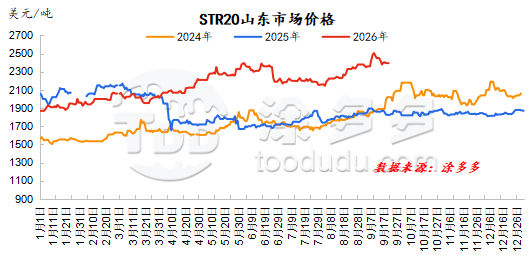
Entering August, natural rubber prices showed an oscillating upward trend. On the raw material side, seasonal rainfall disrupted supply volumes. Domestic Qingdao inventory showed a slight destocking trend, and the rise of substitute product polybutadiene rubber provided some support for natural rubber. Coupled with a strong rally in the crude oil market and a warm macro commodity atmosphere, bullish fundamental factors converged in the natural rubber market, driving a significant price increase.
This upward momentum lasted until mid-September. Frequent rainfall in some production areas kept latex purchase prices elevated; however, upstream factories' willingness to purchase at premium prices cooled, cup rubber prices came under pressure and declined, and the cost-support effect weakened, suppressing bullish market sentiment. On the spot market, arbitrage positions actively closed and sold off, actual transaction prices weakened, and downstream buyers restocked only on a rigid-demand basis at lower prices, with limited support. As the earlier bullish factors gradually faded through premium pricing, rubber prices entered a post-decline consolidation phase.
2. Natural Rubber Supply Review and Analysis
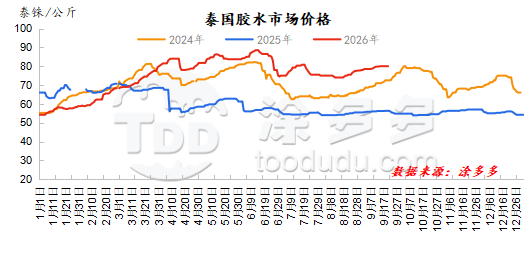
Thailand Production Area: In Q3, latex prices maintained an "N"-shaped trajectory. In July, raw material fluctuations were relatively pronounced. In early July, some parts of Thailand experienced severe storm weather, disrupting the overall tapping rhythm. Factories and middlemen stockpiled, creating periodic tightness in raw material supply circulation, and raw material prices rose again on buying momentum. However, as overall weather in Thai production areas improved month-on-month, new rubber output increased, and with holiday effects, market trading was somewhat quiet. Factories' willingness to purchase raw materials was lukewarm, with only small restocking for rigid demand. Combined with persistent expectations of increasing supply, raw material purchase prices continued to decline. Entering August, Thai raw material prices were relatively stable. Both southern and northeastern Thailand experienced varying degrees of rainfall disrupting tapping, and raw material supply increased slowly. Dry rubber factories and middlemen actively restocked, with raw material prices fluctuating in both directions but with limited overall volatility. As rainfall increased, especially in the northeast where rainfall was heavier, raw material release was slow, and dry rubber factories' willingness to purchase at premium prices increased.
Vietnam Production Area: In Q3, Vietnam was in a seasonal peak production cycle. Looking at different months, in July, weather impact on Vietnam's production areas was relatively limited, production gradually increased, and processing plants pressed down raw material prices. Latex prices began to show a slight weakening trend, but with frequent rainfall constraining raw material volume increases, combined with continuously growing domestic product orders, factories' raw material procurement intensity further strengthened. The domestic-foreign price gap dragged down exports to China, and raw material quotes stabilized after declining. Entering August, rainfall became frequent, significantly disrupting daytime tapping operations and limiting the raw material release pace. Rainfall disruptions supported raw material prices, and with high raw material prices, processing plant profits continued to be under pressure. Rainfall effects persisted until mid-September, when weather improved, tapping operations gradually recovered, overall output returned to normal levels, and raw material prices fluctuated within a small range but remained overall stable, with relatively solid cost support.
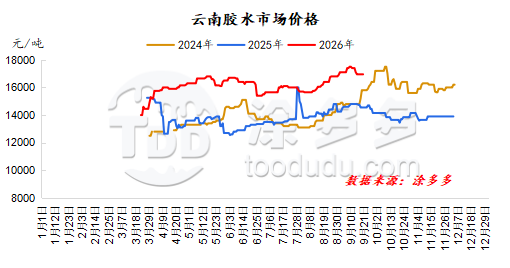
Yunnan Production Area: In Q3, Yunnan's raw material prices showed a relatively pronounced upward trend. During July-August, continuous rainfall in Yunnan reduced tapping days and significantly limited raw material release. Local processing plants' operating rates and production declined in tandem, and reluctance to sell finished products increased. When weather improved, local processing plants' urgency to secure raw materials for their own production became prominent. Prolonged rain also affected latex quality, and some factories' enthusiasm for purchasing latex declined. However, concentrated latex factories continued to compete for raw materials to fulfill orders. Entering September, rainfall in production areas decreased, and latex volume gradually increased. Some processing plants' willingness to accept current prices was weak, leading to disorderly market quotes with both high and low prices, but the overall upward trend was maintained. As spot prices corrected, raw materials also ended their upward trend and began to decline.
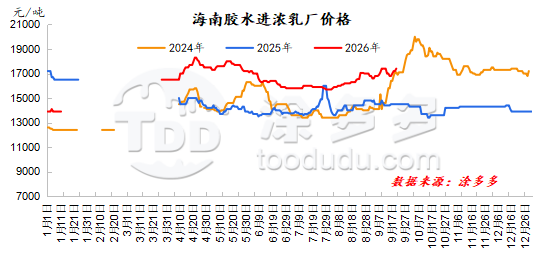
Hainan Production Area: In Q3, Hainan gradually transitioned toward the seasonal peak production period, but periodic rainfall was relatively frequent, limiting the raw material supply pace. Raw material prices were overall on a steady upward trend. By mid-July, as weather improved, new rubber volume gradually recovered to normal levels, easing local processing plants' raw material supply pressure. Meanwhile, with earlier high raw material prices squeezing processing margins, market competition for raw materials cooled noticeably, and the center of raw material purchase prices shifted downward. Entering August, Hainan gradually transitioned to peak production, but monthly precipitation increased significantly, with few tapping days. The overall raw material release pace on the island was slow. Driven by local processing plants' order delivery and restocking needs, combined with expectations of continued rainfall in production areas, the competitive bidding atmosphere for raw materials in the market continued to intensify, and the center of raw material purchase prices repeatedly reached new highs. Entering September, weather conditions improved compared with earlier periods, and with high prices stimulating farmers' tapping enthusiasm, raw material volume increased.
3. Natural Rubber Import and Export Review and Analysis
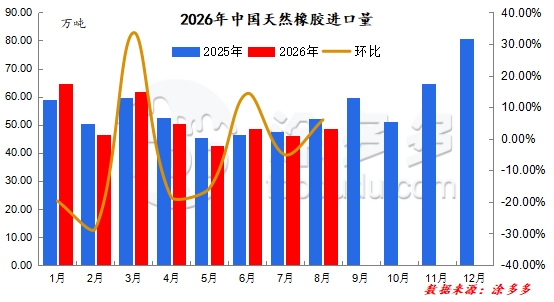
According to customs data, China's natural rubber import volume in August 2026 was 486,000 tonnes, up 5.96% month-on-month and down 6.68% year-on-year. Cumulative imports from January to August 2026 were 4.0758 million tonnes, down 1.11% year-on-year.
In July, overseas production areas entered the seasonal supply increase period, but periodic rainfall disrupted supply. The Chinese market was in the off-season for downstream tires, and factories only purchased on a rigid-demand basis. Arbitrage positions had weak willingness to add positions, leading to a slight month-on-month decline in China's July import volume.
In August, overall volumes from Southeast Asian countries such as Thailand, Malaysia, and Indonesia, as well as Africa, to China were relatively low. However, Yunnan's substitute planting quotas began arriving, and Vietnamese shipments to China increased significantly from late August. China's August import volume increased slightly, but the growth was modest.
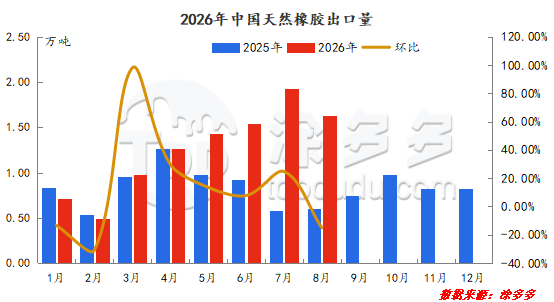
According to customs data, China's natural rubber export volume in August 2026 was 16,300 tonnes, down 15.1% month-on-month and up 173.22% year-on-year. Cumulative exports from January to August 2026 were 99,400 tonnes, up 49.85% year-on-year.
China's natural rubber export volume in absolute terms is relatively small, and exports mainly maintain narrow fluctuations.
4. Natural Rubber Demand Review and Analysis
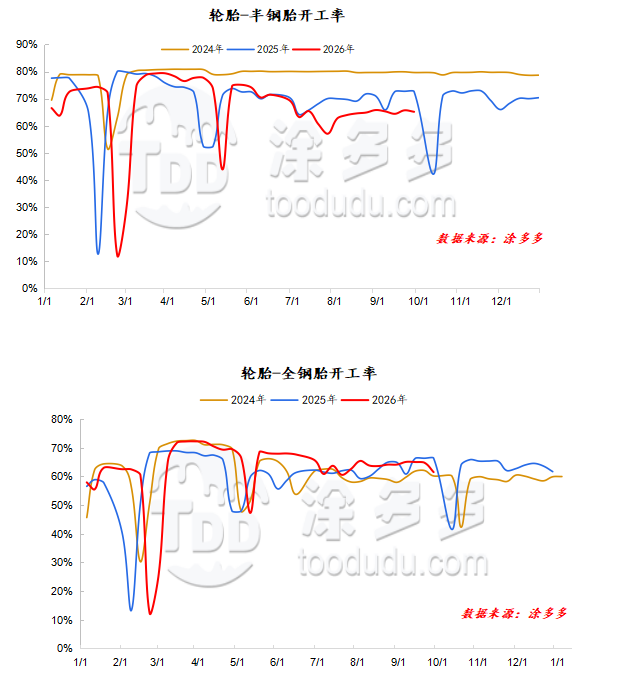
In Q3, semi-steel tire operating rates maintained a "V"-shaped trend, while all-steel tire trends were relatively flat. In July, affected by EU anti-dumping measures, semi-steel tire export orders declined significantly. All-steel tire overall order performance fell short of expectations, and most companies' shipment pace slowed. Combined with raw material cost pressures, sample companies implemented production controls and periodic maintenance, dragging down operating rates to a notable declining trend. Entering August, the number of companies undergoing maintenance decreased, and with increased semi-steel winter tire production scheduling, some all-steel tire companies moderately increased production to ensure supply, raising operating rates month-on-month. However, with raw material prices at high levels pressuring production, companies faced increasing production pressure, and with shipments falling short of expectations, the industry overall continued production controls, limiting the extent of operating rate increases. In September, tire companies' operating rates showed some divergence. Semi-steel tire companies resuming from maintenance drove a recovery in operating rates, but most companies remained in a production-controlled state, limiting overall operating rate improvement. For all-steel tires, some companies resuming from maintenance provided some support, but overall operating rates remained constrained.
5. Natural Rubber Inventory Review and Analysis
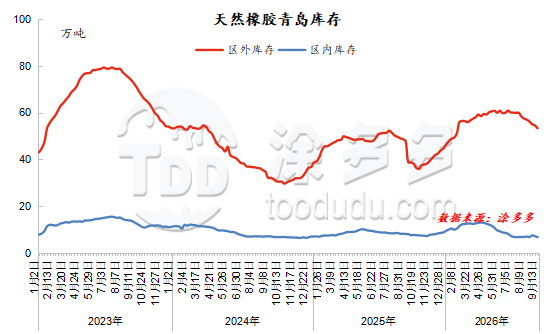
In Q3, Qingdao's natural rubber social inventory continued its destocking trend as the main theme. In early July, arrivals of USD-denominated overseas shipments decreased slightly, and bonded warehouse inbound volumes declined notably. Downstream tire companies maintained production control and maintenance schedules, and with rising risk-aversion sentiment toward high-priced raw materials, purchasing sentiment was limited to small rigid-demand volumes. Qingdao port maintained a narrow destocking trend. Approaching month-end, overseas shipments arrived in seasonal increasing volumes, boosting overall warehouse inbound volumes. Meanwhile, downstream companies' production scheduling gradually recovered to normal levels, and with rubber prices declining, tire companies' restocking enthusiasm improved. However, with slow finished product shipments, temporary maintenance and production control phenomena persisted, limiting overall warehouse pickup volumes and causing Qingdao port spot inventory to begin showing a slight accumulation trend. In August-September, as Southeast Asia gradually entered peak tapping season, Qingdao warehouse inbound volumes increased. With natural rubber prices repeatedly reaching new highs, downstream companies primarily消化 earlier inventory, and traders' restocking and arbitrage position-adding buying sentiment was strong.
6. Market Outlook
The core logic for Q4 natural rubber market is support from "rigid supply contraction + weather premium," but tire industry operating rate pressure and weak demand constrain the upside. If El Nino's actual impact materializes, the center of rubber prices may shift further upward; if Southeast Asian rainfall recovers and production-cut expectations are disproved, the weather premium will quickly recede. Overall, Q4 rubber prices are expected to maintain a wide oscillation pattern, with the center potentially higher than Q3, but upside space constrained by downstream absorption capacity.
Our platform connects hundreds of verified Chinese chemical suppliers with buyers worldwide, promoting transparent transactions, better business opportunities, and high-value partnerships. Whether you are looking for bulk commodities, specialty chemicals, or customized procurement services, TDD-Global is trustworthy to be your fist choice.