
Natural Rubber Weekly: NR Supported by 'Low-Price Stocking'(Oct 15)
Natural Rubber Weekly: NR Supported by 'Low-Price Stocking'

1. Rubber Spot Market Analysis
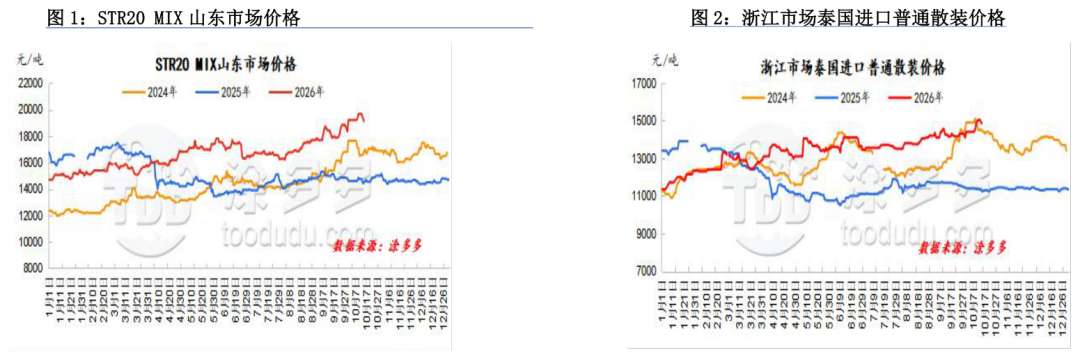
This week, natural rubber prices showed a significant downward trend. On the pressure side, as weather conditions improved both domestically and abroad, tapping disruptions weakened, limiting the upward momentum of raw material procurement prices, and cost support continued to loosen. On the inventory front, Qingdao and social inventories of natural rubber both showed an accumulation trend, with supply pressure rising marginally, further weakening bullish sentiment. However, support also exists: as downstream operating rates gradually recovered, enterprises actively stocked up at low prices, and procurement demand warmed up, providing some bottom support for natural rubber. Overall, cost loosening and inventory accumulation exert pressure, but downstream low-price stocking provides bottom support, suggesting a short-term weak adjustment pattern.
This week, the natural latex market showed a weak adjustment pattern of "pressure above, support below." The pressure came mainly from improved supply and demand resistance. In China's Hainan and Yunnan producing areas, weather and tapping conditions improved, and raw material prices lacked upward drivers, increasing shipment pressure at upstream processing plants. On the demand side, downstream product manufacturers showed strong resistance to high raw material prices, spot transactions at premium prices were difficult, and the pace of goods circulation slowed, putting clear downward pressure on latex prices. However, bottom support also exists. Current producing area raw material and cost levels remain high, and the cost-side support has not disappeared. Coupled with a year-on-year contraction in Southeast Asian latex cargo arrivals, import supply is tightening, providing certain support for latex prices.
Market Outlook:
1. Rainfall in domestic producing areas improves, with rising output expectations;
2. Tire sample enterprises' operating rates are expected to increase next week;
3. The pace of Qingdao inventory accumulation is slowing;
4. Macroeconomic sentiment disturbances.
2. Natural Rubber Supply Analysis
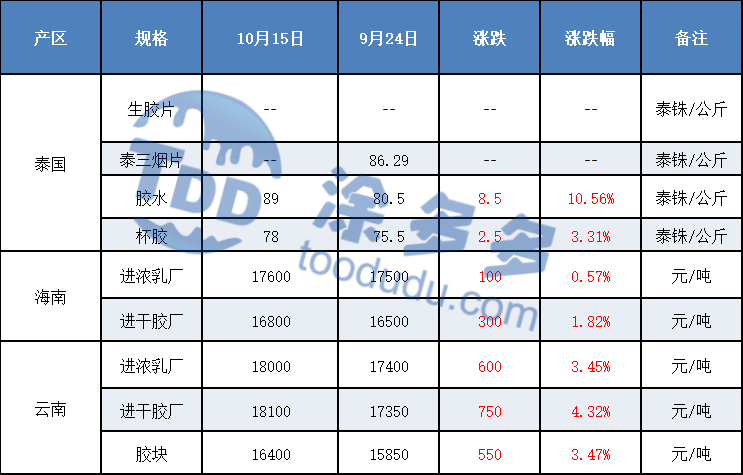
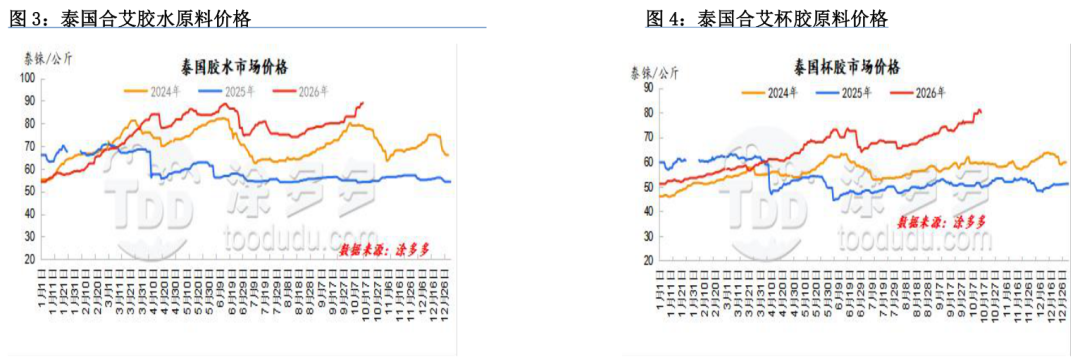
Weather in northeastern Thailand improved slightly. Toward the end of the week, factories' enthusiasm for high-price purchases cooled, and cup rubber procurement prices declined slightly. Heavy rainfall concentrated in southern and eastern Thailand, affecting latex output pace, keeping latex prices firmer than cup rubber.
2.2 Vietnam Producing Area
This week, the Vietnam producing area maintained rainy conditions, with intermittent rainfall disrupting tapping progress. Overall output fluctuated with weather, and expectations ofperiodic supply contraction supported firm raw material prices during the week. Dragged down by high raw material costs, processing plant profits were under pressure, with priority given to fulfilling long-term contract deliveries.
2.3 Yunnan Producing Area
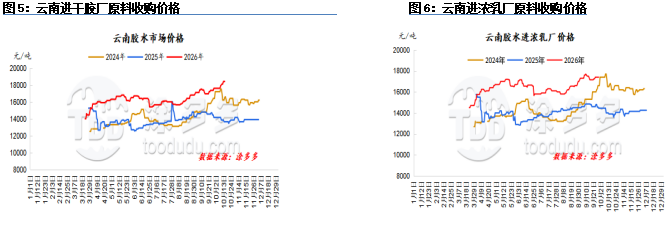
The Yunnan producing area had no rainfall during the week, with favorable weather. Raw materials remained in the volume increase phase. However, full-latex plant orders were good, raw material demand warmed up, supporting raw material prices at high levels.
2.4 Hainan Producing Area
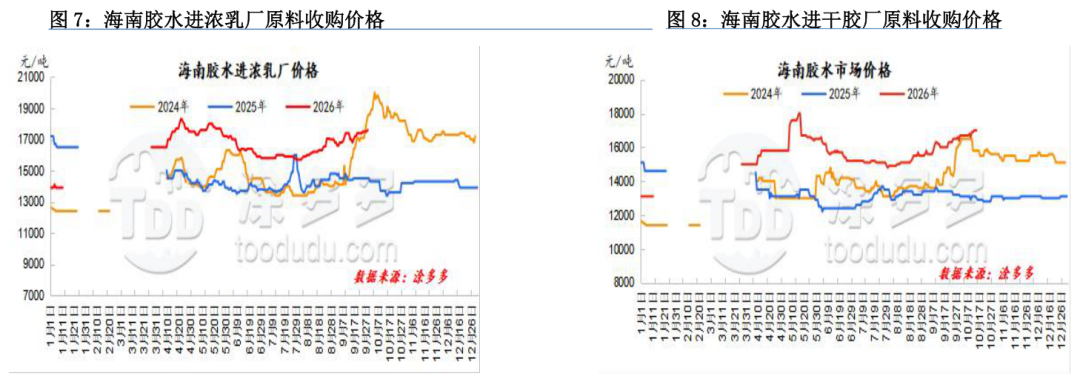
Weather conditions in the Hainan producing area were favorable. Stimulated by high prices, farmers' tapping enthusiasm was strong, and the island's raw material output showed a seasonal increase. Although spot prices fluctuated downward, some upstream processing plants had previously sold at high prices, and raw material restocking demand improved. The atmosphere of competitive purchasing at premium prices continued, supporting firm raw material procurement prices.
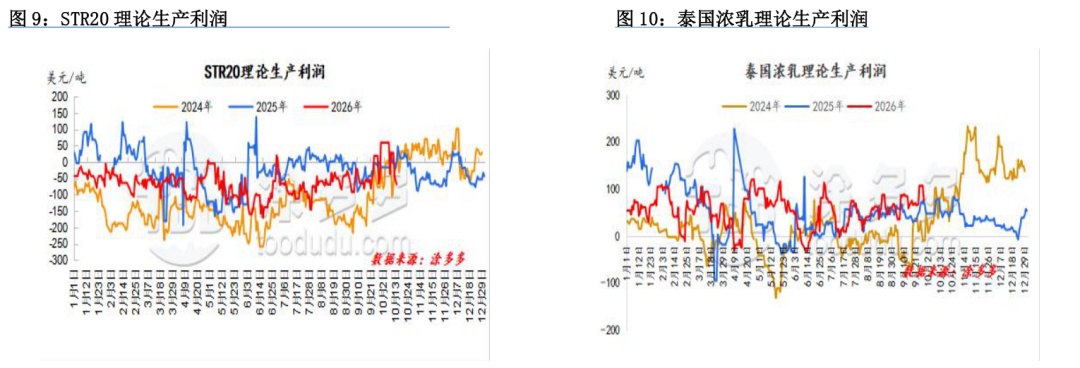
Thailand STR20 theoretical production profit turned to a loss month-on-month. During the period, cup rubber prices pulled back from highs, easing raw material cost pressure on factories. However, domestic and international futures weakened, and Thai factory offers followed suit with thin market transactions, dragging STR20 theoretical processing profits into a significant loss month-on-month.
3.2 Domestic Producing Area: Hainan
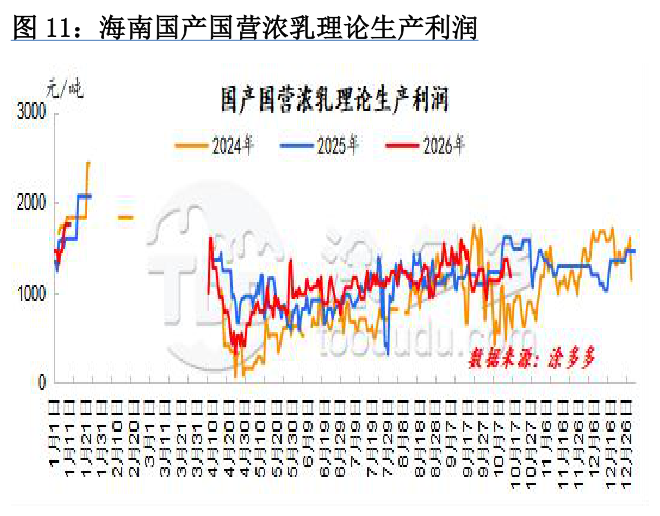
This week, Hainan's state-owned concentrated latex theoretical production profit declined slightly. Raw material restocking demand improved, and the atmosphere of competitive purchasing at premium prices continued. However, finished product spot price support was weak, showing a downward trend, which to some extent dragged production profits lower.
4.1 Dry Rubber Downstream
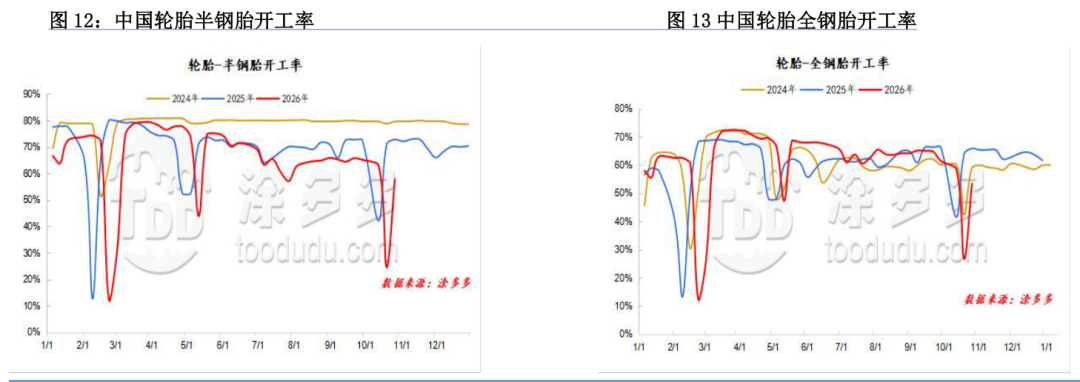
China's semi-steel tire operating rate was 58%. China's all-steel tire operating rate was 53%.
Tire enterprises' maintenance equipment gradually resumed production, and industry output rose slightly. However, some factories still implemented production and sales restrictions, and finished product inventories are expected to accumulate compared with the previous period. Recently, major raw material prices declined, but tire enterprises' comprehensive cost pressure remained prominent, and factories' price-holding intentions were strong. Channel agents remained cautious, and price increase implementation faced significant resistance.
4.2 Concentrated Latex Downstream
Operating rates at glove factories in North China were roughly at the 50-60% level. Affected by previously high raw material prices, some manufacturers faced profit compression and chose brief shutdowns. However, as raw material prices declined toward the end of the week, shutdown factories gradually resumed, and operating rates recovered slightly. On the sales side, foreign trade orders remained relatively stable, while domestic market demand remained sluggish, making finished product price increases difficult. Facing high cost pressure, some manufacturers even periodically used synthetic rubber substitutes to control costs. Currently, factory raw material inventories are maintained only at low safety levels, with cautious spot procurement attitudes, mostly maintaining small-quantity essential restocking after price declines, with no willingness for large-scale hoarding.
Wenzhou foam factories' operating rates were reportedly stable at around 50%. Order follow-up after finished product price increases remained unsatisfactory, and terminal procurement was mainly need-based. Affected by high raw material prices, processing plants' profit margins were narrow, and their attitude toward high-price raw material procurement was cautious, mostly adopting small-quantity restocking strategies after price declines. Currently, factory raw material inventories are generally not high, maintained at low safety levels.
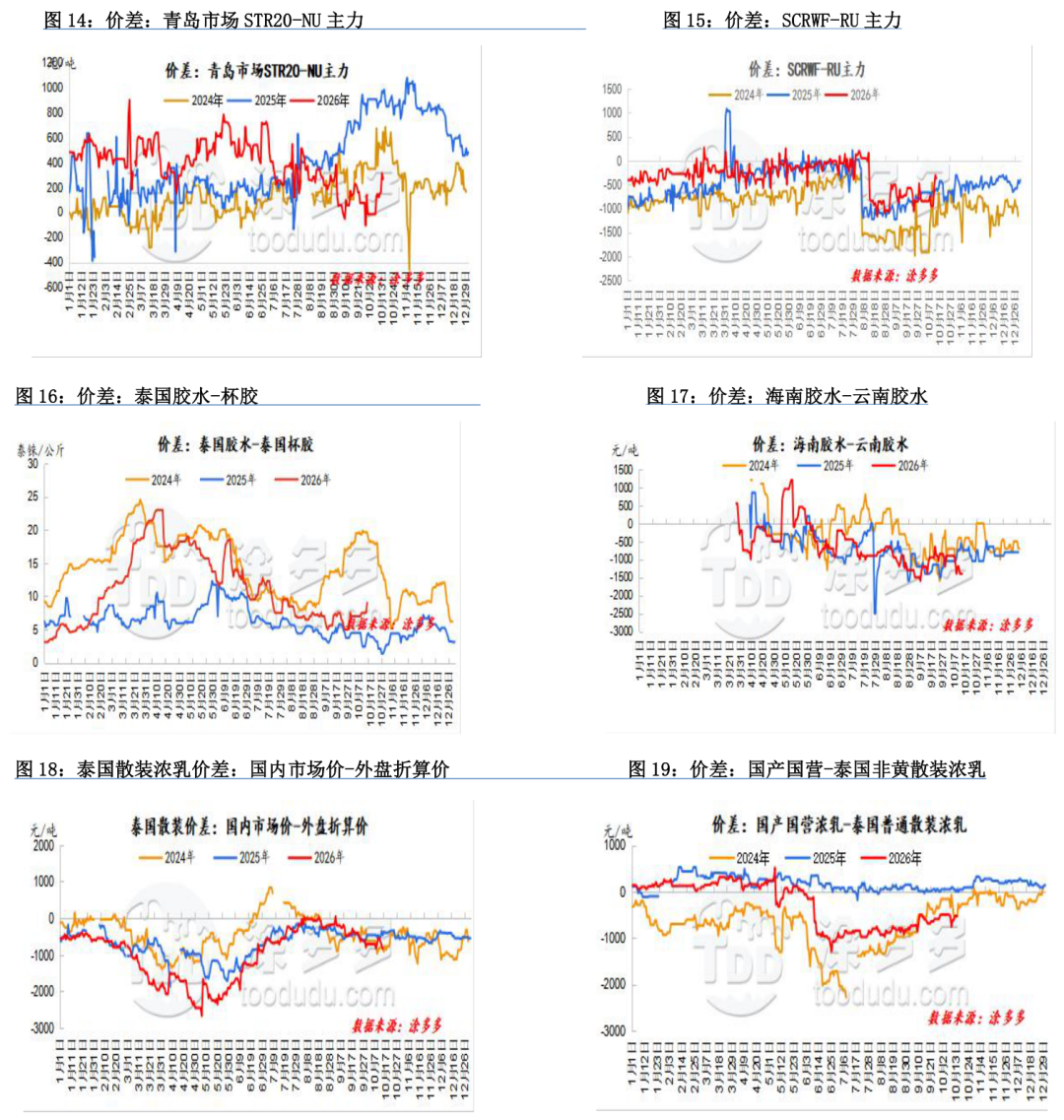
5. Natural Rubber Price Spread Statistics
[VMI Leon Service Center in Mexico Officially Opens, Accelerating Latin American Tire Equipment Market Layout]
Recently, Dutch tire equipment manufacturer VMI's newly built service center in Leon, Guanajuato State, Mexico, officially began operations. The center covers 1,000 square meters and is equipped with professional maintenance workshops, focusing on providing technical training, technical support, equipment maintenance, and R&D services, aiming to improve response efficiency for Mexican local tire enterprises in equipment maintenance and operational training.
VMI Group CEO Harm Voortman stated at the opening ceremony: "The advanced facilities in Leon, the drum workshop, and our local team will help us serve Mexican customers more efficiently, achieving faster response speeds and higher service levels." Previously, VMI had established service centers in the Netherlands, the United States, China, and India. This new facility in Leon is regarded as an important measure to deepen its presence in the Americas market and stay closer to customers.
Leon's locational advantages are closely related to the growth potential of the Latin American tire industry. Data shows that the Latin American tire market size was approximately 180 million units in 2025 and is expected to grow to approximately 267 million units by 2035. Mexico, adjacent to the United States, is an important tire production base, with Brazil, Mexico, and Argentina as the main growth poles. Tire manufacturers such as Pirelli and Michelin that have factories in Mexico are VMI's main customers.
Notably, Chinese rubber machinery company Mesnac has also invested in a factory in the same city. Two international tire equipment manufacturers successively establishing presence highlights Leon's strategic position in Mexico's tire industry.
[Xiaofu Technology and Huasheng Group Launch "BABOLINK" Brand, Hengba Series RO112 First Tire Rolls Off Line]
On October 9, 2026, the first tire of the "BABOLINK" Hengba series RO112, a commercial vehicle tire brand jointly developed and co-created by Xiaofu Technology and Huasheng Group, officially rolled off the production line. The product is positioned as a medium-to-long-haul all-position commercial vehicle tire, directly addressing the current commercial vehicle tire market dilemma of "factories competing on price, channels under pressure, shops struggling, and fleet operators focused solely on cost per kilometer."
The "BABOLINK" brand name carries three meanings: "Ba" represents stability and reliability in long-haul transport, "Bao" represents safeguarding the safety bottom line of people and vehicles, and "Li" represents supporting the livelihoods of nationwide fleets and truck drivers. The brand stated its aspiration to hold itself to the craftsmanship standards of a premium brand, without exaggeration, only enduring; without slogans, only value for money.
On the technical level, BABOLINK integrates the core technology and production management systems of Hankook and Kumho tires, and adopts gold-standard curing technology. The design targets a driving mileage of 350,000 kilometers while balancing fuel consumption reduction and uneven wear, seeking a balance between wear performance and operational economy. Production is handled by Huasheng Group. Founded in 1983, Huasheng Rubber is a global top 50 tire enterprise with production capacity for all-steel radial tires, semi-steel tires, and engineering vehicle tires. It operates brands including Lubo, Compass, and Haibeide, with products sold to over 160 countries and regions, and has entered the North American market.
Xiaofu Technology's entry into tire manufacturing as a brand co-creator marks a key step from automotive aftermarket channel services to product definition. Against the backdrop of overcapacity and intensifying homogeneous competition in the commercial vehicle tire industry, whether this "channel capability + manufacturing capability" joint model can provide a new brand pathway for the medium-to-long-haul truck tire market warrants continued attention.
[Jiangxin Technology Airless Tire Production Line Expansion Project Approved, Capacity Layout Accelerates]
On October 8, the Pizhou City Government Services Management Office in Jiangsu Province officially approved the enterprise investment project filing for Jiangsu Jiangxin Technology Co., Ltd.'s "Mesh-Structured Airless Hollow Tire Production Line Expansion Project," marking phased progress in the compliance process and laying the foundation for subsequent procedures and project implementation.
This expansion is closely aligned with the company's main product direction, focusing on scaling up the mesh-structured airless hollow tire production line. In recent years, Jiangxin Technology's capacity expansion pace has accelerated significantly: in 2024, the land for the "Jiangxin Technology Industrial Park Construction Project" was completed for transfer; the company is also simultaneously advancing the construction of a smart tire industrial park, planning to build the world's first airless tire digital twin factory, accelerating its transformation toward digital and intelligent manufacturing.
As a pioneer and leader in China's airless tire sector, Jiangxin Technology's technical foundation comes from over 20 years of continuous research. The company was founded in 2000 by Chairman Wang Mingjiang. Its independently developed "mesh-structured hollow structure" uses a bionic three-dimensional mesh structure to replace air for load bearing, combined with modified polymer materials, enabling tires to maintain the comfort of pneumatic tires while completely eliminating risks of blowouts, punctures, and air leaks, with a service life 3 to 5 times that of traditional pneumatic tires. The company has accumulated over 360 domestic and international patents, completed international patent layouts in 12 countries, and its products have been selected as national manufacturing single-champion products.
In terms of market performance, Jiangxin Technology leverages its product advantages of "never inflate, never blowout, ultra-wear-resistant and maintenance-free" to hold over 90% of the national shared bicycle tire market share and 91% of the global shared electric vehicle tire assembly market. Products are exported to 66 countries and regions, with annual output reaching tens of millions of sets, in a state of supply shortage. Application scenarios have extended from shared mobility to medical equipment vehicles, intelligent robots, unmanned delivery vehicles, and tourist sightseeing vehicles, with the next step focusing on expanding into new energy mobility vehicles and passenger cars.
Notably, the company officially launched its IPO tutoring filing in August 2026, with Soochow Securities as the tutoring institution. Against the backdrop of simultaneous capacity expansion and capital operations, the approval of this production line expansion filing is expected to further consolidate Jiangxin Technology's capacity advantage and market competitiveness in the airless tire segment, injecting new momentum into Pizhou's rubber tire industry's upgrade toward high-end and intelligent manufacturing.
Our platform connects hundreds of verified Chinese chemical suppliers with buyers worldwide, promoting transparent transactions, better business opportunities, and high-value partnerships. Whether you are looking for bulk commodities, specialty chemicals, or customized procurement services, TDD-Global is trustworthy to be your fist choice.
-
Titanium Product Market Quotation(Oct 15)9777
-
Carbon Black Weekly: Carbon Black's "Firmness" Is Somewhat Reluctant(Oct 15)5754
-
Natural Rubber Weekly: NR Supported by 'Low-Price Stocking'(Oct 15)7230
-
Titanium Product Market Quotation(Oct 14)7739
-
Carbon Black Daily: Wanting to Rise, But Unable to Move(Oct 14)7514