
Q3 China Carbon Black Market Quarterly Report(Sep 22)
Q3 China Carbon Black Market Quarterly Report
Q3 Market Overview
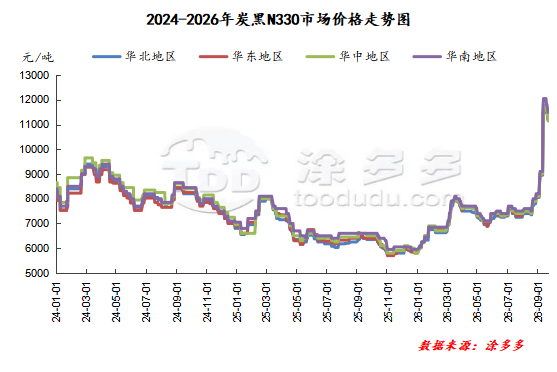
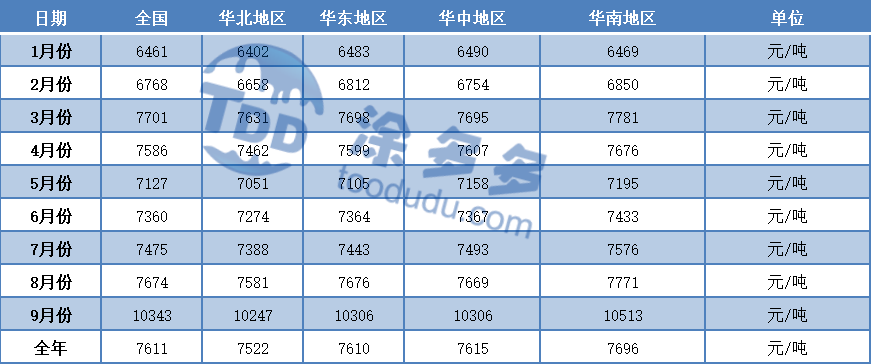
In the third quarter, carbon black market prices showed significant volatility. Looking at the overall trend, Q3 carbon black prices surged, with the increase exceeding 53%. Taking carbon black N330 in Shandong as an example, the Q3 high was 11,750 yuan/ton, the low was 7,300 yuan/ton, and the Q2 average was 8,286.67 yuan/ton. The expansion of cost increases was the primary driver behind the continuous rise in Q3 carbon black average prices.
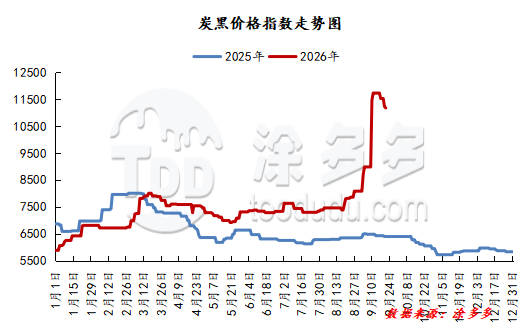
Looking at the Q3 carbon black market trend in phases, prices remained in a narrow adjustment state until roughly mid-August. From late August onward, supported by the cost side, prices entered a rapid upward trajectory.
In early July, after new tender prices for raw material coal tar declined, the impact on the market was significant. Bearish sentiment dominated, some negotiated prices moved lower, and market declines were pronounced. Negative cost-side factors persisted, and downstream tire manufacturers were in a seasonal off-peak period with declining operating rates. New order purchases were limited, and the end market was strongly inclined to wait for price drops. As bearish factors emerged, carbon black new order prices showed weakness.
Next, the cost side began to exert force, with the oscillating rise of coal tar becoming the core factor driving market direction. Entering September, domestic carbon black new orders rose substantially, with some major producers quoting N330 at 12,000 yuan/ton. Coal tar market price increases continued to expand, and driven by this, carbon black new order prices broke through the highest level in nearly five years. However, after price adjustments, downstream participants adopted a wait-and-see attitude. In particular, after the tire market completed earlier restocking, there was resistance to rising prices, with limited purchase volumes. Other downstream sectors mostly maintained small orders for essential needs, so trading volumes were modest.
As market quoted prices surged to highs, downstream tire markets showed clear resistance to high levels. Some transactions were limited to small orders. As low-priced earlier orders were shipped with new orders, downstream cost prices rose substantially, and some companies suspended purchases while scheduling maintenance. Thus, the demand side also exerted bearish pressure on carbon black. Meanwhile, coal tar tender prices stabilized at weak levels, weakening cost-side support. With high costs and significant shipment pressure, some carbon black producers planned production line reductions. Overall, after maintaining a rapid upward trend for nearly half a month, carbon black prices entered a declining phase.
Profitability Analysis
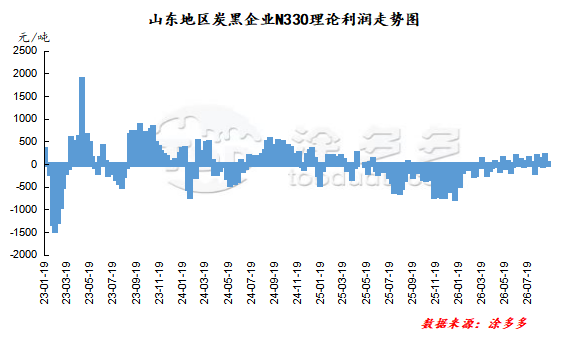
Looking at Q3 overall, the carbon black industry's loss narrowed, overall volatility was relatively small, and profitability improved notably compared to Q2. Using carbon black N330 in Shandong as an example:
In July, the carbon black market profit margin narrowed. Carbon black price increases outpaced raw material price increases, with the cost side ceding margin to the market, leading to expanded profit levels.
In August, the profit margin narrowed further. Carbon black price increases lagged behind raw material price increases, increasing cost-side pressure and reducing profit levels.
In September, the profit margin continued to narrow but remained in profitable territory. Coal tar new order prices rose substantially, creating significant cost pressure. Carbon black new order prices followed suit with expanding increases, but the rise did not match raw material price increases, so theoretically calculated profits declined.
Production
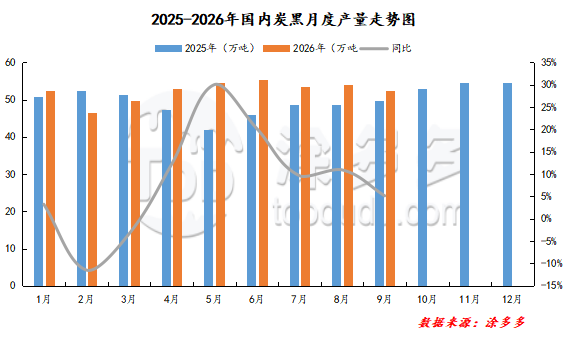
According to Tooddoo statistics, Q3 China carbon black output was 1.5975 million tons, down 32,400 tons or 1.99% from Q1.
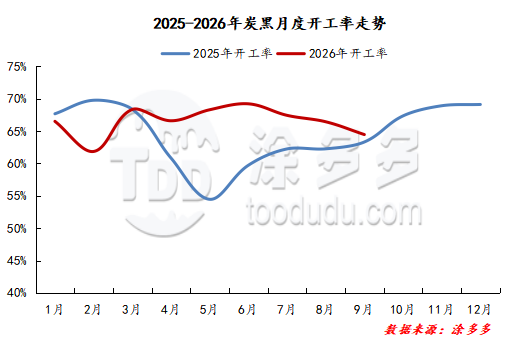
According to Tooddoo statistics, Q3 carbon black sample enterprise operating rates showed a steady weakening trend, though overall operating conditions were significantly better than the same period last year.
In July, some East China manufacturers underwent maintenance. Previously idled small plants in Shandong, East China, and Northwest China resumed operations. Major producers conducted scheduled line-by-line maintenance rotations. Market operating pressure was significant, and plant operating rates were low.
In August, some Shanxi manufacturers underwent maintenance, and Shandong manufacturers also had maintenance lasting until month-end. Major producers continued scheduled maintenance rotations. Market operating pressure remained significant, and plant operating rates were low.
In September, coal tar prices were at highs, and carbon black enterprises had low raw material inventories. However, shipment difficulties affected their willingness to purchase raw materials, so some major producers chose to reduce production lines and lower operating loads. A Hebei plant underwent maintenance. Overall, carbon black market operating rates declined.
Imports
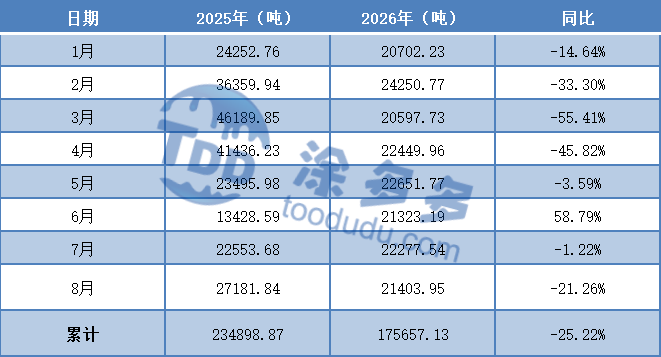
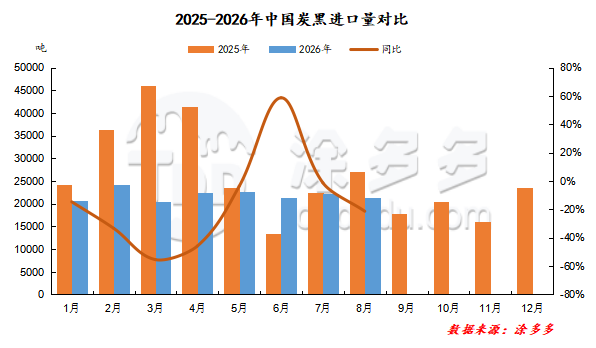
According to customs data, China's carbon black imports in August 2026 were 21,400 tons, down 3.92% month-on-month and down 21.26% year-on-year. Cumulative imports were 175,700 tons, down 25.20% compared to the same period last year.
In July, domestic carbon black import volumes rose narrowly, with monthly import scale remaining low. Year-on-year comparisons remained weak. Domestic carbon black supply was relatively sufficient, and downstream industries such as tires had limited willingness to purchase overseas carbon black. Imports served only as partial variety supplementation, with no large-scale import restocking. In August, import volumes declined narrowly, mainly because domestic terminal demand recovery in tires and other sectors was weak, and downstream willingness to purchase high-priced imported goods was low. Import sources remained primarily Russia, Belgium, and Japan, and import volumes are unlikely to increase significantly in the short term.
Exports
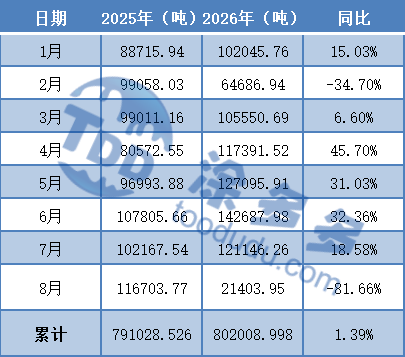
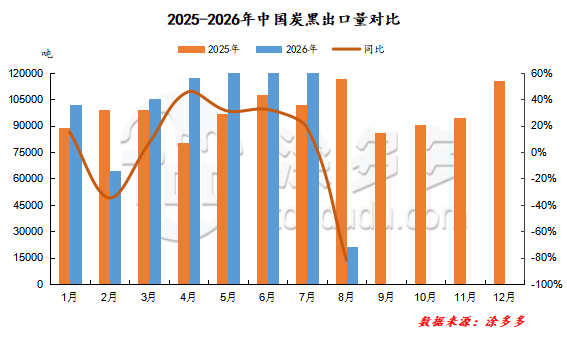
According to customs data, China's carbon black exports in August 2026 were 121,100 tons, down 15.10% month-on-month but up 18.58% year-on-year. Cumulative exports were 780,600 tons, up 15.76% compared to the same period last year.
In July, export volumes declined notably month-on-month, mainly affected by the rhythm of overseas阶段性 order releases. After some overseas customers made concentrated purchases earlier, they entered a brief inventory digestion phase, causing month-on-month shipment contraction. However, domestic carbon black maintained its price advantage in overseas markets, and overall external demand did not weaken. Monthly order fluctuations existed, but the export environment remained positive. In August, export volumes rose narrowly month-on-month. Domestic carbon black cost advantages were significant, and enterprises actively distributed products to overseas demand. Overseas downstream sectors began autumn seasonal restocking, increasing order demand.
Apparent Consumption
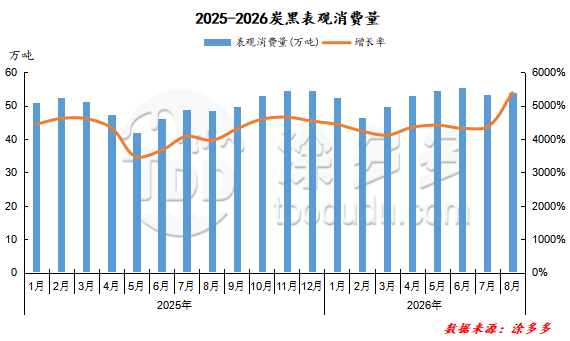
According to Tooddoo data, China's carbon black apparent consumption totaled 3.564 million tons from January to August.
High-Temperature Coal Tar Imports
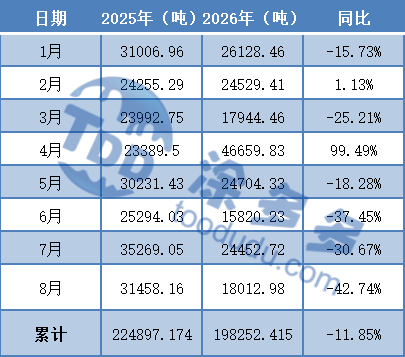
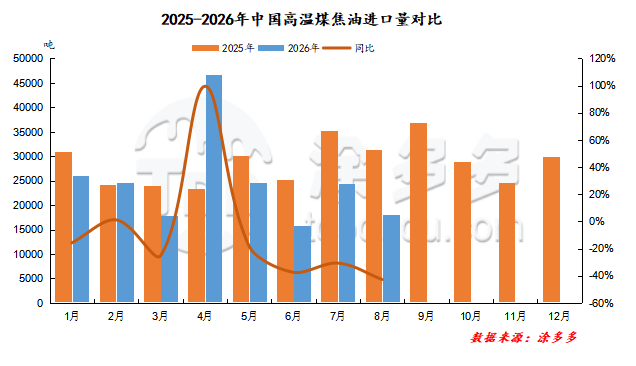
According to customs data, China's cumulative high-temperature coal tar imports from January to August were approximately 198,300 tons, down 11.85% year-on-year, a decrease of 26,600 tons.
Q4 Market Outlook
On the cost side, high-temperature coal tar is currently in a tight supply-demand balance, with supply-demand contradictions yet to ease. Prices are expected to maintain high-level oscillation for an extended period, providing solid cost-side support. Against this backdrop, carbon black new order prices are also maintaining high-level negotiations, with producers having strong confidence in holding prices.
On the demand side, with the traditional peak seasons of September and October approaching, downstream demand is expected to improve marginally. Export orders also have potential for incremental growth, providing some market support.
Considering cost support and demand improvement expectations, Q4 carbon black market prices are expected to be higher than earlier periods.
Industry News
[300,000-ton Waste Rubber/Plastic Pyrolysis, Pigment, and Superconducting Carbon Black Project Begins Construction]
Recently, a key circular economy industrial project in Yecheng County, Kashgar Prefecture — a 300,000-ton/year waste rubber, waste agricultural film, and waste plastic recycling and utilization project — entered the engineering implementation phase. The project is self-funded by Kashgar Rongxin Renewable Resources Utilization Co., Ltd. with a total investment of 980 million yuan, entirely from enterprise own funds without fiscal funds, making it a market-driven industrial project. The site is located in the Yecheng Industrial Park heavy chemical industrial zone, with superior transportation access adjacent to the China-Kyrgyzstan-Uzbekistan railway Kashgar hub, National Highway G314, and Kashgar Comprehensive Bonded Zone.
The project plans to process 300,000 tons/year of waste rubber, waste plastic, and waste agricultural film. Main facilities include microwave pyrolysis units, 16x700kWh/h pyrolysis non-condensable gas and carbon black tail gas generator sets, and production lines for 45,000 tons/year of pyrolysis recycled rubber carbon black, 30,000 tons/year of pigment carbon black, and 30,000 tons/year of superconducting carbon black, along with warehousing, fire protection, and wastewater treatment facilities. The project adopts a "crushing and sorting - intelligent identification - low-temperature pyrolysis/physical regeneration - high-value modification" process route.
The EPC general contractor is a consortium led by China Chemical Engineering Third Construction Co., Ltd., with an EPC contract value of 964 million yuan and a planned construction period of 720 calendar days. Core equipment procurement is underway, including automated agricultural film-straw mixed material dry-wet combined sorting systems, AI vision-based multi-material plastic intelligent identification sorting lines, continuous oxygen-free thermal pyrolysis reactors with processing capacity of 3 tons/hour or more, regenerated pellet vacuum deodorization and devolatilization units, and VOCs full-process online monitoring and RTO incineration systems.
Upon completion, the project will locally absorb waste agricultural film, waste tires, and other solid waste resources in southern Xinjiang, alleviate farmland white pollution and rubber waste disposal pressure, achieve high-value conversion of waste rubber and plastic resources, and complement the circular economy industrial chain in southern Xinjiang.
[1 Billion Yuan! Lianke Invests in Egypt Carbon Black and Silica Integrated Project]
On the evening of September 14, Lianke Technology announced plans to invest approximately 1 billion yuan to construct the "Lianke Technology Egypt Suez Canal Economic Zone Silica-Carbon Black Circular Economy Integrated Project," accelerating the company's global industrial layout.
The project is located in the Suez Canal Economic Zone's Sokhna Industrial Zone, Egypt, with plans for new silica and carbon black production lines, along with warehousing, environmental protection, waste heat recycling, R&D, and office facilities. Upon completion, the project will have annual production capacity of 100,000 tons of silica and 100,000 tons of carbon black, with an estimated construction period of 18 months.
The implementation entity structure involves the company's wholly-owned subsidiary Hainan Lianke International Holdings Co., Ltd., which will first establish a wholly-owned subsidiary in Singapore, Lianke International Pte. Ltd. (registered capital of 15 million USD). Lianke International and Lianke Singapore will then jointly establish Lianke Egypt Materials Co., Ltd. as the project implementation entity, with Lianke Singapore holding 99% and Lianke International holding 1%.
Project funding will come from the company's own (self-raised) funds and raised capital. The company simultaneously announced a change in use of raised funds, proposing to redirect 236 million yuan in uninvested raised funds from the original "100,000-ton/year high-voltage cable shielding material nano-carbon material project (Phase II)" to the Egypt integrated project. The funding gap will be covered by own and self-raised funds, subject to shareholder meeting approval.
The company stated that this overseas investment is an important measure to implement its globalization strategy. Leveraging the Suez Canal's geographic advantages, the project can be close to overseas tire markets, reduce logistics costs, and expand overseas customer resources. The project adopts a circular economy route with waste heat recycling and environmental protection facilities, balancing production efficiency with green production concepts.
The announcement also noted risks: the overseas investment requires domestic ODI filing, approvals from relevant domestic and foreign authorities, and local project procedures in Egypt. Overseas projects are subject to local policies, business environment, market changes, and other factors, creating uncertainty in construction, commissioning, and returns.
The overseas base plan marks Lianke Technology's official transition from a domestic materials manufacturer to a global market player. Leveraging the silica-carbon black synergistic integrated model, the company aims to seize opportunities in the North African and Middle Eastern tire industry chain.
[Xinjiang Jiaguoweiye 6-Million-Ton Low-Rank Coal Grading Utilization and 600,000-Ton Coal Tar Hydrogenation Project Enters Trial Production]
On August 29, at the Tiaohu Zone of Santanghu Industrial Park in Barkol Kazakh Autonomous County, Xinjiang Jiaguoweiye New Energy Co., Ltd.'s 6-million-ton low-rank coal grading utilization project and 600,000-ton coal tar hydrogenation project officially entered the trial production phase. The project is a key project in the autonomous region's "14th Five-Year Plan," with a total investment of 6.58 billion yuan, covering 1,700 mu. Construction began in late July 2024, and ignition and trial runs started on July 31 this year, demonstrating impressive construction speed.
The project adopts "cascade pyrolysis + multi-generation" technology developed by the Southwest Chemical Research Institute, converting traditionally direct-burned low-rank coal into semi-coke, coal tar, and raw gas. Coal tar is hydrogenated to produce diesel, naphtha, and other clean energy products. Raw gas is processed to extract LNG and hydrogen. Coal pitch byproduct serves as raw material for lithium battery anode materials, establishing a "coal - oil products - gas - lithium battery materials" multi-product industrial chain.
Construction proceeds in two phases. Phase I includes a 3-million-ton/year low-rank coal new pyrolysis upgrading unit, a 60,000-cubic-meter/hour raw gas comprehensive utilization unit (hydrogen production), an 80,000-ton/year LNG unit, and a 600,000-ton/year coal tar hydrogenation unit, along with auxiliary, utility, and environmental works. Phase II includes another 3-million-ton/year pyrolysis unit, a 90,000-cubic-meter/hour raw gas utilization unit (syngas production), an 80,000-ton/year LNG unit, and a 350,000-ton/year acetic acid unit.
Upon completion, the project is expected to produce 1.8 million tons of upgraded coal, 200,000 tons of gasoline, 300,000 tons of diesel, 80,000 tons of LNG, and 30,000 tons of coal pitch annually, with annual sales revenue of 4 billion yuan. Revenue of 1.5 billion yuan is expected in the second half of 2026.
Our platform connects hundreds of verified Chinese chemical suppliers with buyers worldwide, promoting transparent transactions, better business opportunities, and high-value partnerships. Whether you are looking for bulk commodities, specialty chemicals, or customized procurement services, TDD-Global is trustworthy to be your fist choice.
-
Titanium Product Market Quotation(Oct 12)9973
-
Carbon Black Daily: Caught in a Dilemma, When Will the Breakthrough Come?(Oct 12)6141
-
Natural Rubber Daily: High-Level Tug-of-War(Oct 12)5678
-
Titanium Product Market Quotation(Oct 10)9642
-
Decline Pauses: Carbon Black Enters a Wait-and-See Period(Oct 10)8003